
Will the Sisson Project bring a third life to Napadogan?
A critical-minerals proposal referred to the Major Projects Office offers both hope and déjà vu in central New Brunswick

The one-hour drive from Fredericton to Napadogan feels longer than the map suggests and is best done in daylight to avoid the risk of colliding with a moose. The settlement sits in central New Brunswick, surrounded by forest and acting as a gateway to the historic salmon fishing pools of the Southwest Miramichi River.[1] Napadogan was a product of the railway.[2] Halfway between Moncton and Edmundston, it served as a crew-change point and locomotive service stop.[3] After steam gave way to diesel, the roundhouse was converted into a veneer mill in 1960, producing wood for crates for Jaffa oranges grown in Israel.[4] Later, it manufactured the veneer for furniture, crutches, lobster traps, flooring, hockey sticks, and skateboards.[5]
The veneer mill had always led a wobbly existence. Reports as far back as 1961 describe it opening and closing for short periods. But the first major shutdown came in 1980, after the provincial government allegedly refused to guarantee a supply of wood needed to produce veneer for crutches.[6] My father, Ted Samuel, had been a customer, and the provincial government offered him a $64,000 loan to restart the mill on the condition that he include component manufacturing. Samuel ran the mill for more than two decades, employing up to 150 people. In 2003, following a troubled expansion, the mill’s secured creditors, which included the provincial government, pushed the operation into bankruptcy. Samuel, in his mid 70s, retired. The government then orchestrated the sale of the mill to Atcon, a politically connected New Brunswick construction firm that later went bankrupt in 2010, triggering significant financial and political controversy.[7] Subsequent owners struggled to maintain operations.[8] Today, Napadogan is largely abandoned.
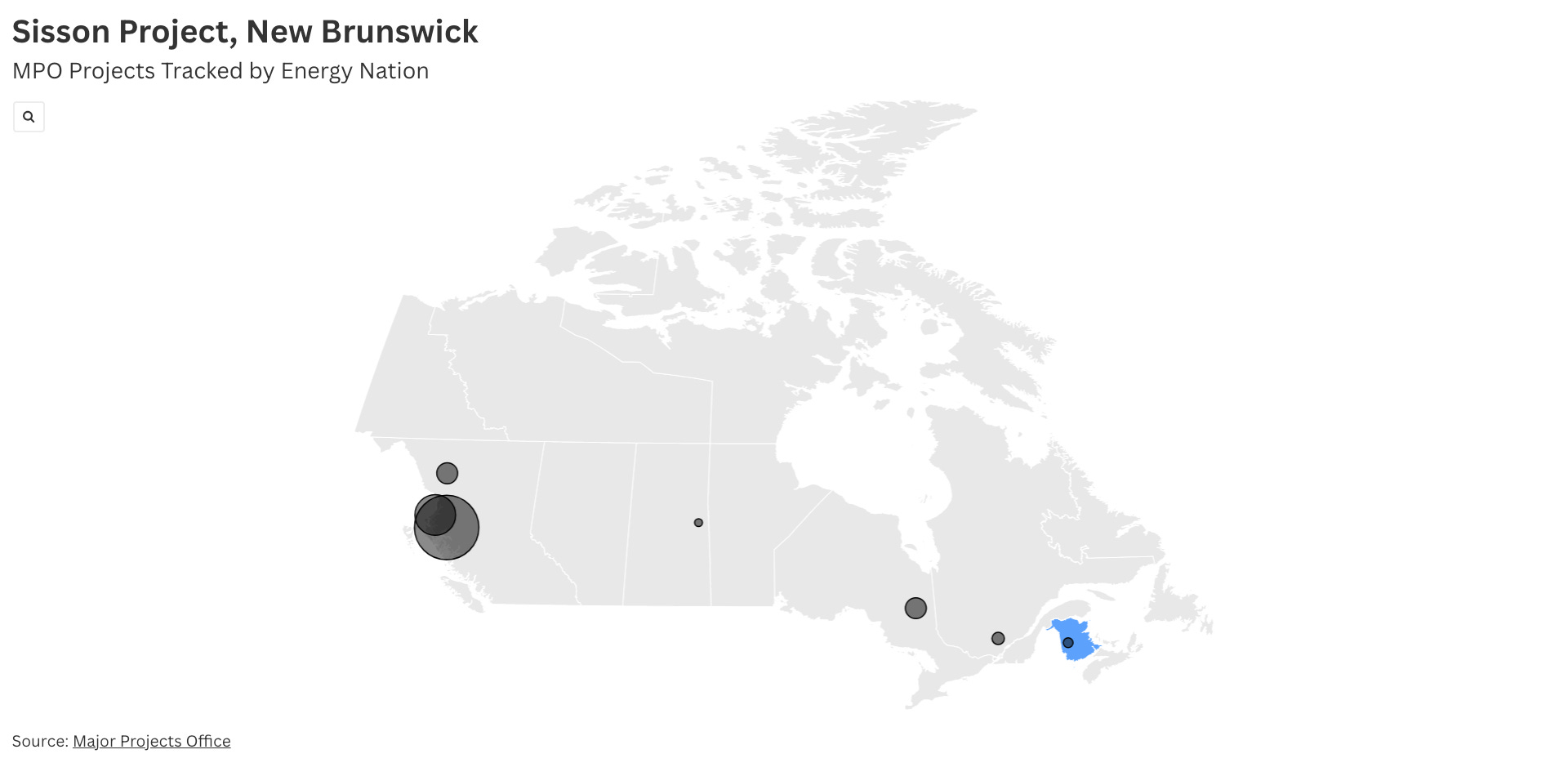
Attention has now shifted to what might come next. That “next” is not Waylon Napadogan, though I’m a fan, but the Sisson Project, a proposed open-pit tungsten-molybdenum mine roughly 10 kilometres southwest of Napadogan. First proposed in 2005, the project completed its environmental impact assessment (EIA) in 2017 to process and refine ore on-site, requiring a tailings storage facility roughly the size of 1,500 NFL football fields, as well as a new 42-kilometre, 138-kilovolt transmission line.[9]
What follows is a data story examining whether this long-delayed critical-minerals project could reshape the fortunes of Napadogan for a third time.
I highly recommend clicking here to view the full interactive data story for dynamic charts and layered narrative. Below is a static reproduction.
Curious subscribers seeking additional historical background and context from a personal perspective are encouraged to read the notes below.
The Sisson Project, proposed by Northcliff Resources, is an open-pit tungsten-molybdenum development in central New Brunswick, near the largely abandoned settlement of Napadogan. The area holds personal significance: my father, Ted Samuel, operated a veneer mill there that employed up to 150 local residents from 1981 until 2003. As part of Canada’s Major Projects Office portfolio, Sisson carries strategic relevance for energy-transition supply chains. At the same time, it reflects the complex and extended development paths often associated with major resource projects in rural and remote areas.
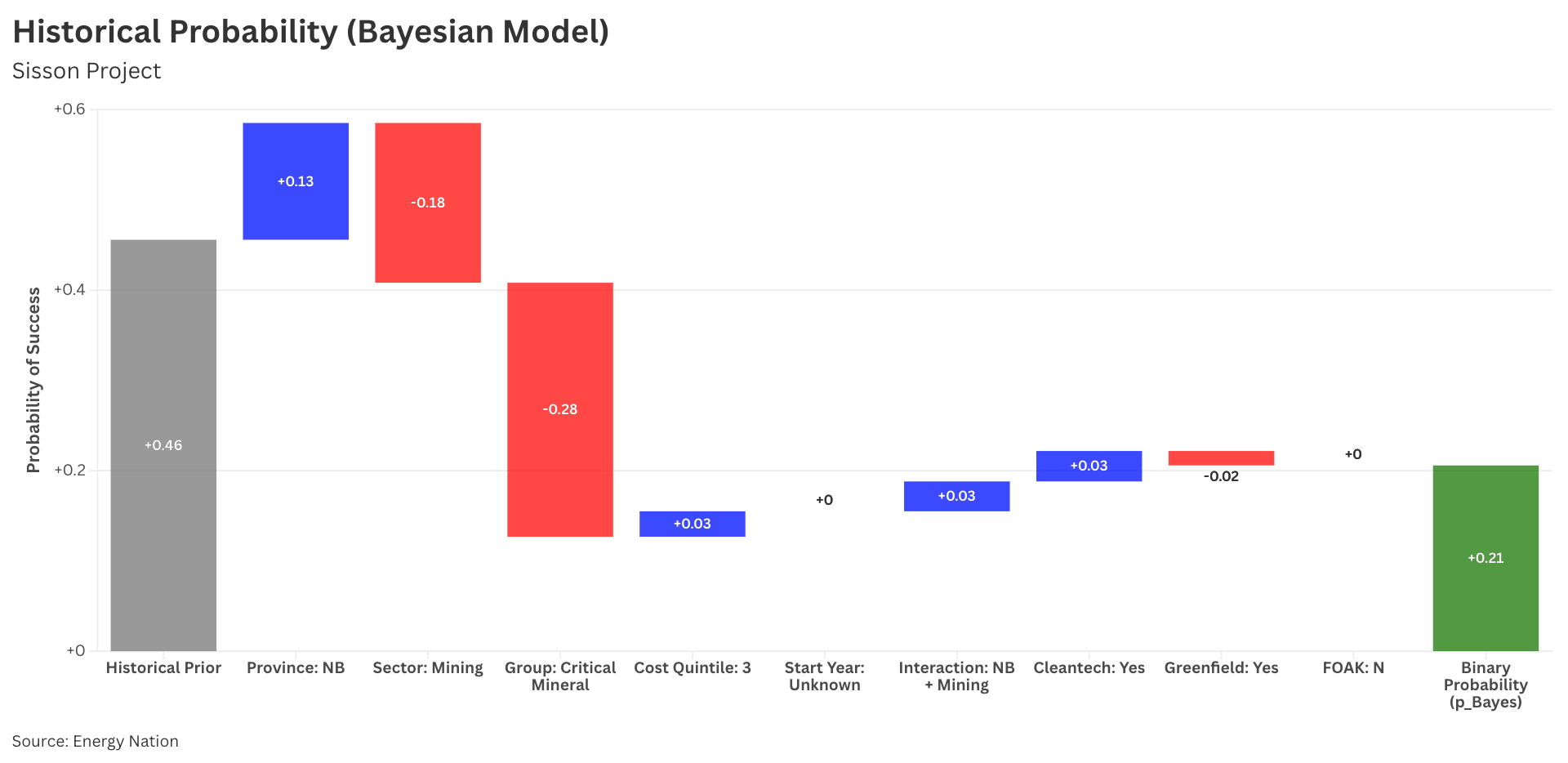
Sisson’s historical probability begins with a national prior rate of 46%. New Brunswick raises the probability, but the Mining sector and the Critical Minerals group drive it downward, reflecting historical permitting and financing challenges for comparable projects. Positive effects from NB-Mining interactions and cleantech status partially offset these pressures. The final Bayesian estimate of 21% represents Sisson’s binary likelihood of entering construction and highlights the structural factors that shape its development pathway.
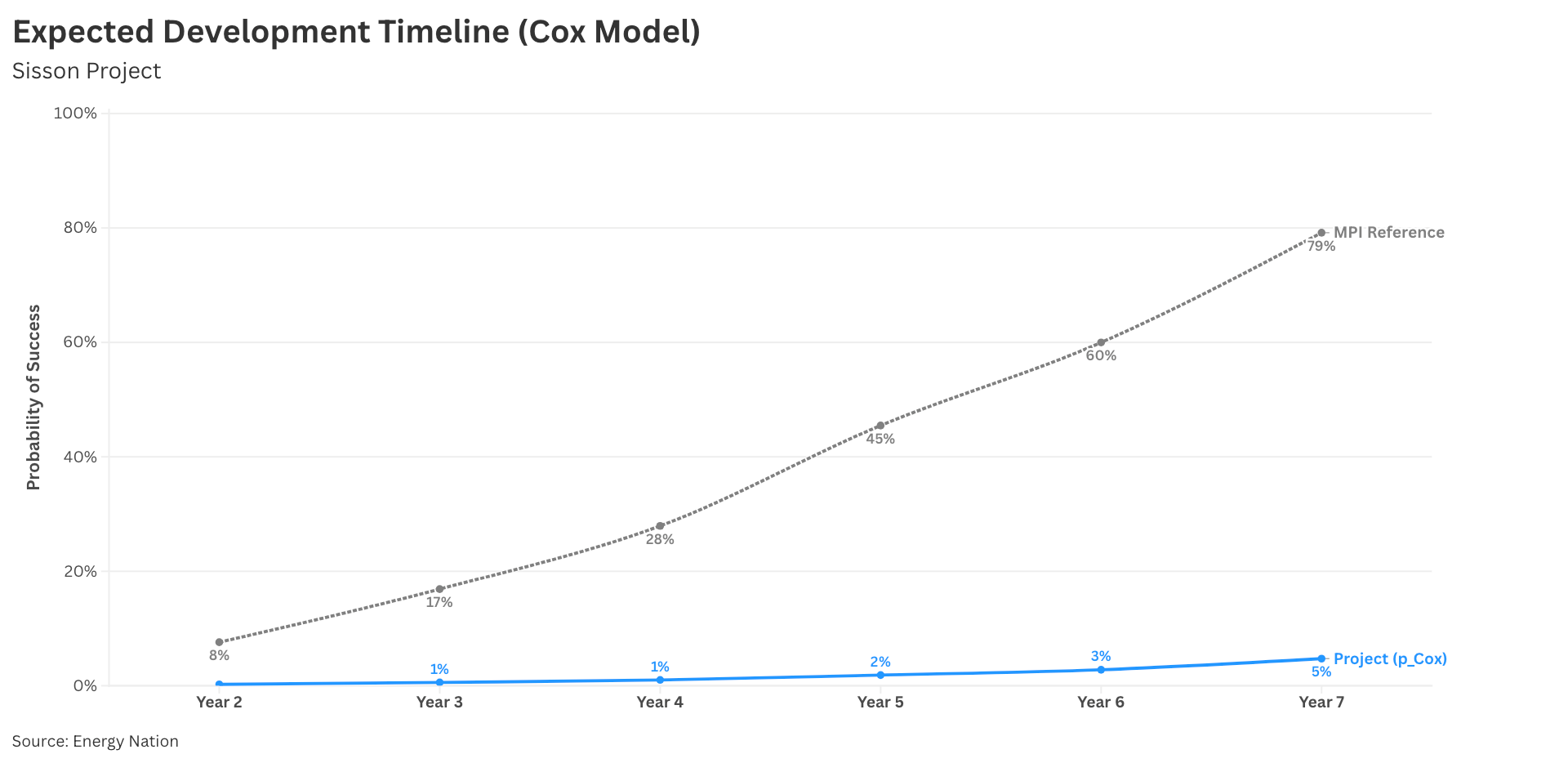
The benchmark probability for major projects to reach an investment decision is nearly 80% by Year 7 (Alberta Energy projects). Sisson’s probability is only 5% (or 2% by Year 5), reflecting historically long approval timelines for mining developments. The underlying driver is a very slow development clock, captured in the model’s hazard ratio (for technical readers). The results suggest that extended timelines, rather than project fundamentals, are the dominant constraint.
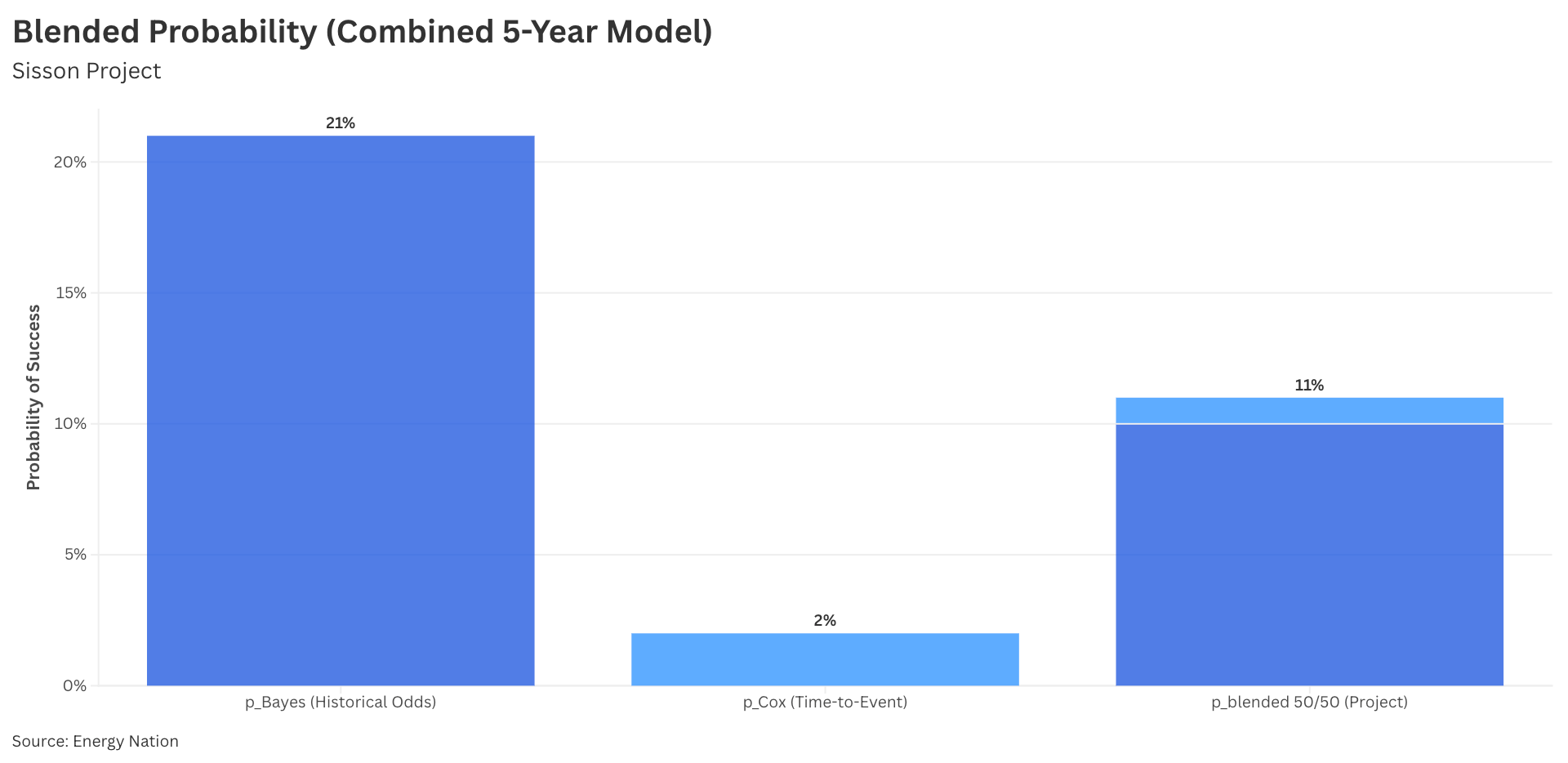
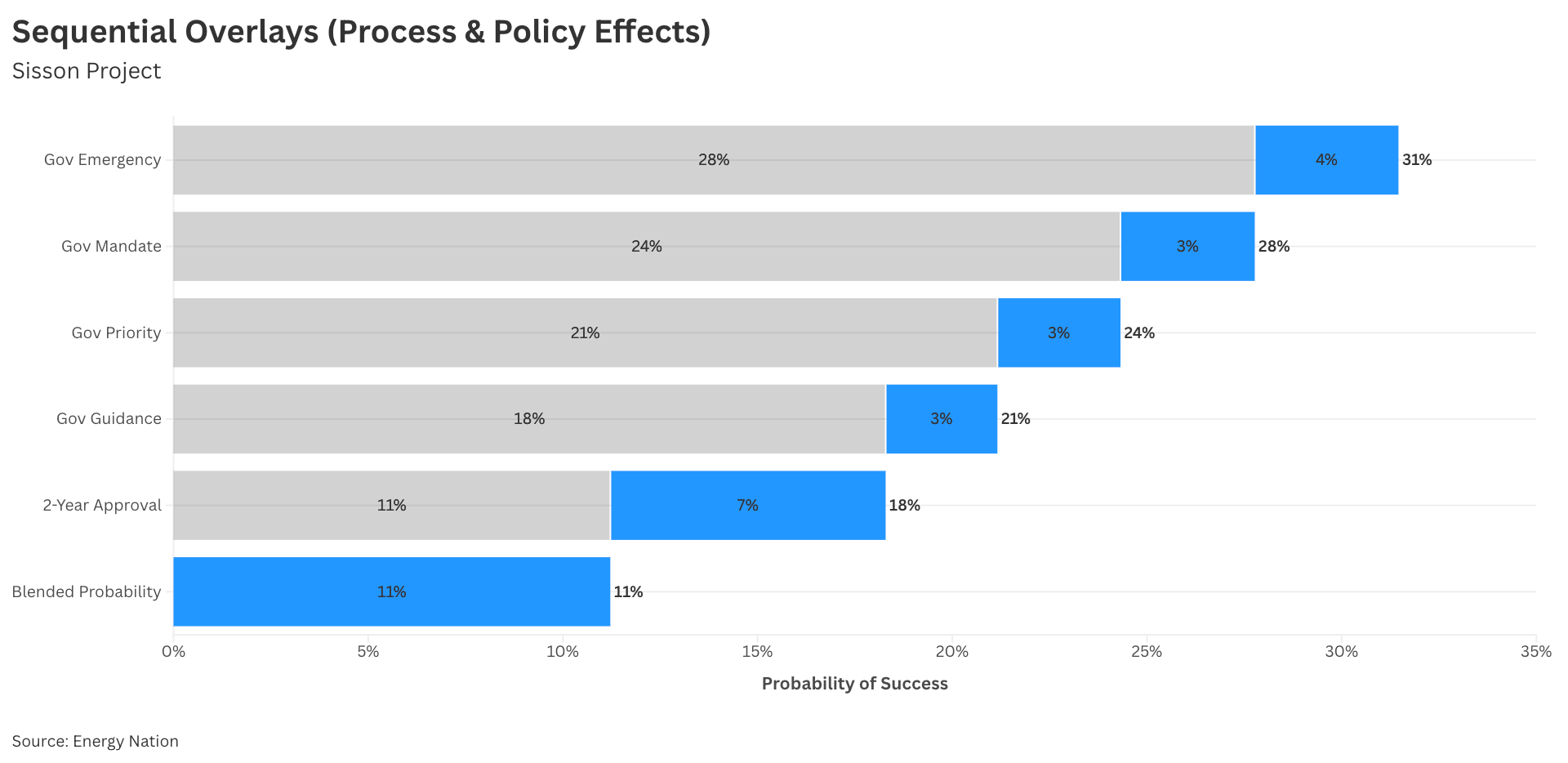
The project’s historical odds (p_Bayes of 21%) and its expected development clock (p_Cox of 2% over five years) are combined to produce a 50/50 blended probability of 11%. This value reflects both the project’s long-term viability and its historically slow progression toward an investment decision. It represents the baseline outlook under prevailing conditions and suggests that, without changes to process or timelines, progress is likely to remain gradual.
In a series of counterfactual scenarios, sequential overlays increase Sisson’s probability of success from its 11% baseline. A two-year approval decision cap, reflecting a compressed regulatory timeline, raises the probability to 18% by directly addressing the project’s primary constraint. Additional policy-related scenarios provide further incremental uplift, with coordinated signals raising the probability into the 24% to 31% range. These modelled effects illustrate how greater procedural certainty and alignment could influence the trajectory of slow-moving but persistent projects such as Sisson.
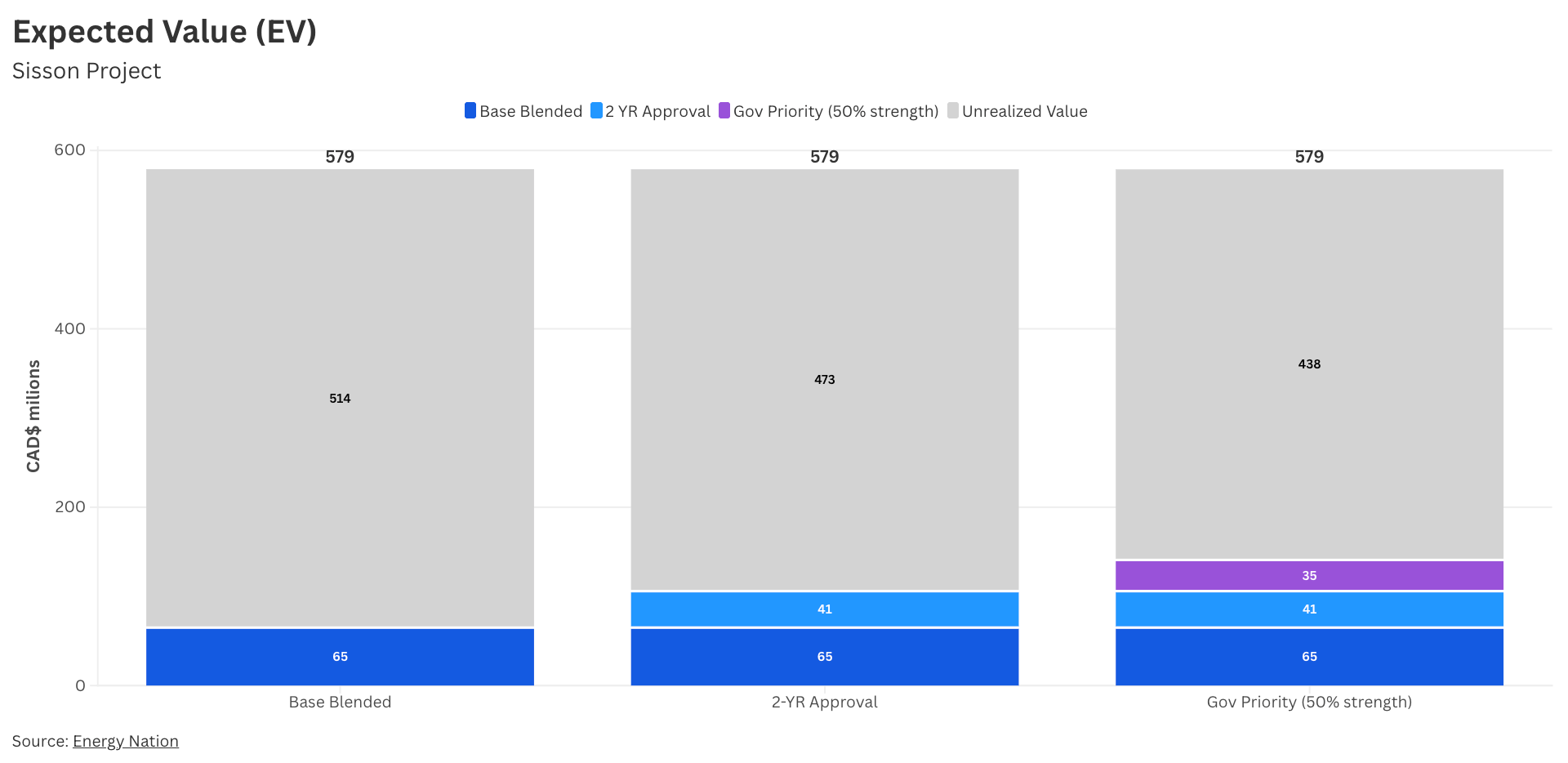
The project’s total cost is estimated at $579 million. At the baseline blended probability derived from historical data, about $65 million of this value is realized. In counterfactual scenarios, compressing the approval decision timeline increases realized value to $106 million, reflecting a higher likelihood of an investment decision. A Priority-level policy environment, broadly aligned with the type of coordinated attention of an MPO referral, raises realized value further to $141 million. The remaining unrealized portion underscores how much of the project’s economic potential depends on progress toward successful development.
Notes:
[1] Two companies control nearly 80 kilometres of the Southwest Miramichi River, from roughly 10 km above Boiestown to Juniper. The upper section, near Napadogan, is owned by J.D. Irving Ltd., while the lower section, historically held by Canadian Pacific and International Paper, is now owned by Avenor (source: Competitive Enterprise Institute, Atlantic Salmon and the Miramichi River). Access to this stretch of river, including its well-known salmon pools, is tightly restricted. Both companies employ wardens who patrol the area around the clock to protect against uninvited visitors. The structure of private river ownership and controlled access is illustrated in the Southwest Miramichi River Map (map: Miramichi Salmon Association).
[2] Napadogan was also the site of the first deployment of Canada’s only segregated Black military unit, the No. 2 Construction Battalion. In late January 1917, approximately 250 men from the battalion in Truro, Nova Scotia, were sent to Napadogan to dismantle railway tracks that the Canadian government required for military rail lines in Belgium and France (Canadian Encyclopedia).
[3] The Napadogan Subdivision forms part of Canadian National’s mainline crossing New Brunswick, a route that has long served as a key east-west freight corridor (Napadogan Subdivision overview). Napadogan grew into a significant operational hub from the 1930s through the 1950s, with CN owning several homes for its workers. The CN manager’s house later became the place my father stayed when he visited the mill.
[4] In 1961, the Government of Israel contracted with the mill’s owners, Atlantic Veneers Ltd., for three million board feet of veneer slats to make the lightweight, durable “Haarbaz”-style citrus boxes used to ship Israel’s orange harvest to markets across Europe and beyond. The contract employed about 60 people at the mill (Daily Gleaner, August 29, 1961).
[5] Canadian molded-plywood furniture expanded rapidly after the Second World War, when manufacturers previously involved in aircraft production adapted their tooling and techniques to produce bent-plywood components for civilian use. The postwar boom in schools, churches, and community halls created strong demand for stacking chairs, which were versatile, space-saving, and economical alternatives to fixed pews or heavy wooden benches. The design foundations for modern bent-plywood furniture were laid in the 1930s by firms such as PEL (Practical Equipment Ltd.) in Britain and by Finnish designer Alvar Aalto. By the 1950s, several Canadian companies were specializing in curved and molded plywood. One such firm was Curvply, founded in 1949 by Ted Samuel in an old flax mill in Orono, Ontario, where it manufactured curved plywood parts for furniture makers (Orono Weekly Times). A sister company, Plydesigns, went on to produce complete furniture pieces including the award-winning Roo Chair. For context on the evolution of molded-plywood furniture in Canada, see Design in Canada: Fifty Years From Teakettles to Task Chairs.
[6] The veneer mill has had several owners over its history. First appearing as Atlantic Veneers Ltd. in 1960, it was purchased by Bathurst Paper in 1963 for box making in Toronto and Montreal and later acquired by Calley and Currier of Bristol, New Hampshire. By 1980, its primary output was veneer used in the manufacture of plywood crutches. Bob Urie, then president of Calley and Currier, alleged that the provincial government was withholding access to wood because the firm refused to relocate its entire operation to New Brunswick. The government denied this, arguing instead that producing veneer required only the highest-quality logs and that the process was inherently wasteful. In their view, those premium logs should go to sawmills, industries dominated by larger companies and influential families, rather than to a small veneer producer. See “Dept. Says Had No Role in Closure of Plant.” The Moncton Transcript, 4 Dec. 1980, p. 37. Also see CBC Archives, “Napadogan Mill (1980-12-04) – Edited item – CFP-0040.” In October 1981, Ted Samuel formed Veneer Products of N.B. (1981) Ltd., which acquired the mill’s assets for a nominal sum and received a $64,000 loan from the Province of New Brunswick to restart operations (Daily Gleaner, October 31, 1981, p. 3). In September 1986, a fire destroyed the mill, and the company received a total of $250,000 from provincial and federal agencies to rebuild. The mill reopened in July 1987 (Daily Gleaner, July 23, 1987, p. 19) until its bankruptcy in February 2003.
[7] The history of the Atcon Group of Companies in New Brunswick is a well-documented case of financial and political controversy in the late 2000s and 2010s. The Miramichi-based construction firm headed by Robert Tozer collapsed in 2010 despite receiving $70 million in provincial loans and guarantees. The New Brunswick Auditor General later concluded that these guarantees had been issued without adequate due diligence or oversight (National Post; CBC News). The Atcon bankruptcy resulted in $50 million in taxpayer losses. In 2013, New Brunswick’s conflict-of-interest commissioner ruled that then-premier Shawn Graham had violated provincial ethics rules by approving loan guarantees for Atcon while his father, Alan Graham, was serving on the company’s board and was fined $3,500 (CBC News). In 2014, the province filed a lawsuit against Atcon’s auditors, Grant Thornton, although the Supreme Court of Canada ultimately ruled that the action was too late and could not proceed (CBC News). Alan Graham, himself a long-time politician, served as New Brunswick’s Minister of Natural Resources and Energy from 1991 to 1998 under Premier Frank McKenna and as Deputy Premier from 1997 to 1998. In this role, he would have been well acquainted with forestry operations across the province, including the Napadogan mill when it was owned by Ted Samuel.
[8] When Atcon collapsed into bankruptcy in 2010, the Napadogan mill was purchased by another politically-connected owner. One partner was Kirk MacDonald, a serving provincial Progressive Conservative MLA in the David Alward government and a former New Brunswick cabinet minister whose Fredericton-York riding includes Napadogan. The other was Jennifer Leduc Allen, the wife of then federal Conservative MP Mike Allen, who served in the Stephen Harper government and represented the riding of Tobique-Mactaquac, which also includes Napadogan. MacDonald lost re-election in 2018, and one year later, in 2019, Leduc Allen pleaded guilty to exceeding the legal limit on contributions and financing to her husband’s 2016 Progressive Conservative leadership campaign. (CBC News). In May 2022, MacDonald and Leduc Allen sold the mill to From the Forest, a Wisconsin-based engineered-flooring manufacturer, which subsequently renamed the operation ThorHammer Veneer. At the time of the sale, the mill was reported as not accepting logs, and its current operational status is unclear.
[9] The environmental impact assessment for the Sisson Project proceeded through parallel provincial and federal review processes, each with its own consultation timelines for regulators, the public, and First Nations. The Government of New Brunswick issued its EIA approval to Sisson Mines Ltd. on December 3, 2015 (GNB EIA Registry). On February 10, 2017, the Province of New Brunswick and the province’s six Maliseet (Wolastoqey) First Nations signed an accommodation agreement concerning the project (IAAC Registry). The Government of Canada subsequently issued its federal EIA approval on June 23, 2017, following completion of the federal assessment under CEAA 2012 (IAAC Registry).