

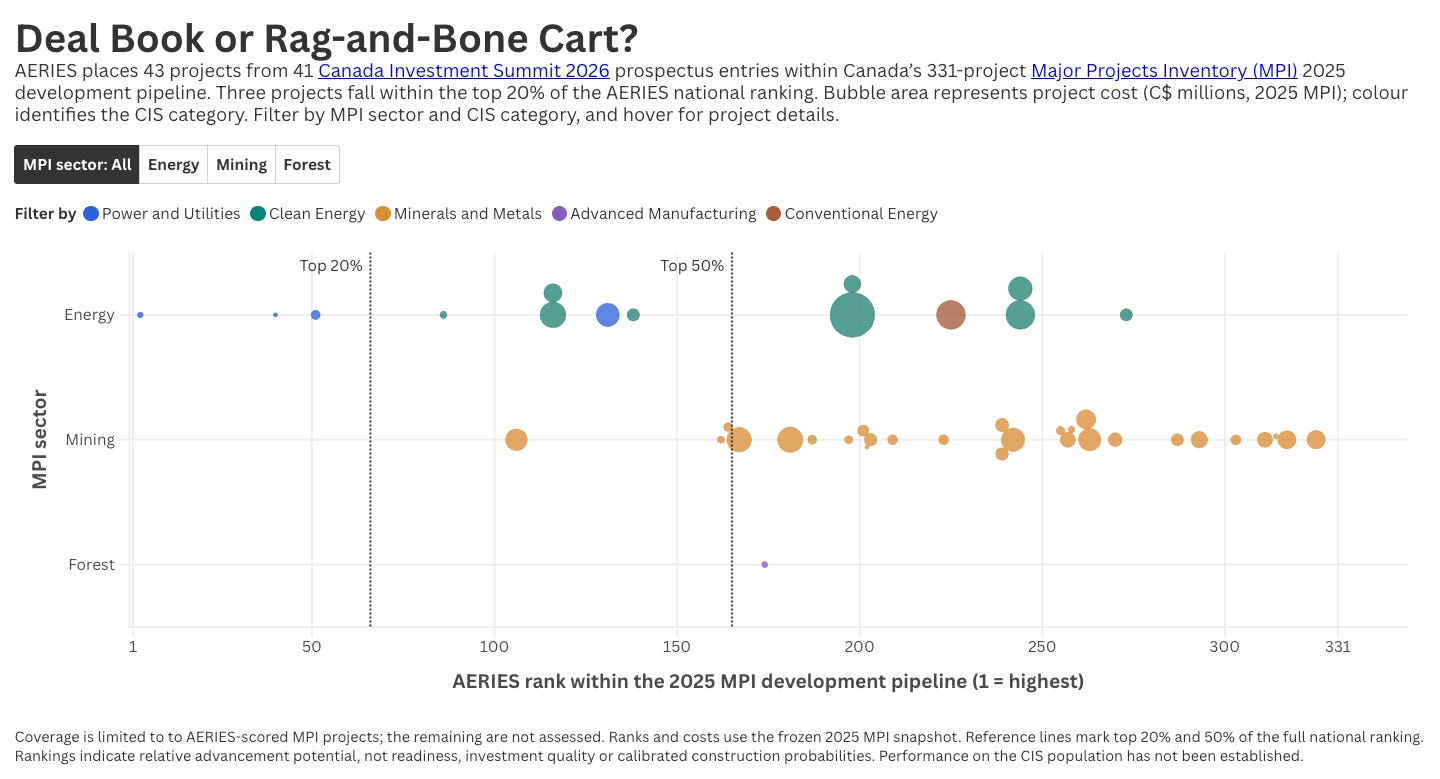
Here’s an update to the data story and dataset for the AERIES-ranked Canada Investment Summit projects.1 I added three projects that were missed in the initial scan. Project names are not always easy to match across the source material.

The additions do not materially change the overall complexion of the results or the earlier observations. If anything, further reflection on the list reinforces my view of how challenging the Summit pipeline is. Prime Minister Carney’s promotion effort starts to look less like a deal book and more like a rag-and-bone cart.
What caught my attention was how far down the AERIES national ranking so many of the covered Summit projects sat. Before drawing conclusions about individual projects, I wanted to understand what might explain that broader pattern. The data story explores sector and geography, two important influences on AERIES rankings, to help answer that question.
While AERIES does not pick winners (it ranks contenders by their potential to advance to construction), my own working estimate of the probability that a randomly selected pre-construction CIS project attracts direct investment through the Summit would be on the order of 7%. That is my judgment, not an AERIES forecast. But I think it is the right order of magnitude.2
Here’s my logic. The full CIS prospectus contains 167 entries. Seven are already described as under construction, leaving 160 development-stage entries. Of those, 15 are described as permitted or shovel-ready.3 At least four of the 15 are still explicitly seeking major commercial or offtake arrangements.4 That leaves at most 11 projects, or about 7% of the development-stage portfolio, that appear to meet my basic screening criteria for financing by a large investor.
Even that figure should be treated with caution. Silence does not mean contracting is complete, financing is secured or policy frameworks are sufficiently predictable to support institutional investment.
AI-enabled Energy Resource Inference and Expectation System.
For context, 23 of the 361 projects in our 2024 MPI backtest entered construction in 2025, a rate of 6.4%. AERIES’ experimental 2026 forecast anticipates about 22 entries among the 246 projects with annual probabilities, or 9%; another 85 MPI projects lack annual estimates. These figures put the 7% judgment in perspective, but do not validate it. Attracting investment through the summit and entering construction within a year are different outcomes.
Applying the strict textual test (status explicitly says “shovel-ready,” “fully permitted,” or all permits obtained/in place), I count 15: Project Northern Lights, Gold Creek, Ksi Lisims/PRGT, Alberta Industrial Heartland, True North Gold, Great Atlantic Salt, Rose Lithium, PC Silver, Goldboro Gold, NA Helium liquefaction, Cariboo Gold, Project Titan (Phase 2), Melford Terminal, Qik Port, and MTC’s glulam facility. But three more sit right on the line: Dumont (”Construction-ready”), Halifax’s NEXT (”construction-ready brownfield expansion”), and Point Tupper (wind partially permitted, hydrogen fully permitted). Depending on where you draw it, an honest range is 15–18.
At least four” means it could be five. Within the shovel-ready set, the Financing Objectives explicitly seeking offtake or commercial counterparties are: Project Northern Lights (long-term offtake agreements), Gold Creek (commercial partnerships through processing agreements), Rose Lithium (equity tied to long-term offtake), PC Silver (offtake among its list), and arguably Melford (offtake partner as one option).